
Traditional Boarding School: 4 Reasons It Still Shapes Future Success
Traditional Boarding School: Why Does It Still Matter Today?
For many parents, the idea of sending a child to a boarding school raises an important question.
Why choose a traditional boarding school in an increasingly modern and connected world?
Is boarding simply about living away from home? Is it only associated with historic British schools, strict routines, and academic pressure?
The answer is much bigger than that.
A well-designed traditional boarding school creates an environment where education continues beyond the classroom. Students learn to manage their time, become part of a community, develop independence, and receive support as they navigate both academic and personal growth.
But not every boarding school experience is the same.
That is why, before choosing a school, families need to understand what boarding actually looks like—and what type of environment is the right fit for their child.
What Is a Traditional Boarding School?
At its core, a traditional boarding school combines academic education with residential life.
Students do not simply arrive for classes and return home at the end of the school day. They live within or closely connected to the school community, sharing everyday experiences with fellow students while receiving pastoral and academic support.
This creates a very different educational experience.
A student’s day may include:
- Academic lessons and independent study
- Structured routines and responsibilities
- Sports, clubs, arts, and co-curricular activities
- Shared meals and community life
- Time with friends from different backgrounds
- Guidance from teachers and boarding staff
- Increasing personal responsibility
The result is an environment where students are not only prepared for examinations but also gradually prepared for life beyond school.
1. Independence Is Built Through Everyday Experience
One of the biggest differences between boarding and day school is that students learn independence through practice.
Managing study time, organising daily routines, communicating with others, and taking responsibility for personal choices are all part of everyday boarding life.
Importantly, independence does not mean students are left alone.
The right boarding environment combines freedom with structure and support. For example, d’Overbroeck’s describes its boarding approach as balancing structure, flexibility, and personal attention, while creating a supportive community where students are also expected to take responsibility for being part of it.
For international students especially, this transition can become an important part of their personal development.
2. Education Continues Beyond the Classroom
A strong traditional boarding school recognises that some of the most important learning happens outside formal lessons.
Living with other students exposes young people to different personalities, cultures, perspectives, and ways of thinking. Activities, friendships, shared responsibilities, and daily interactions all become part of the educational experience.
This is particularly relevant for students preparing to study at university.
University life requires more than good grades. Students need to manage their own time, communicate effectively, adapt to new environments, and become comfortable making decisions independently.
Boarding can give students the opportunity to begin developing these capabilities earlier.
3. Community Can Become a Second Home
For parents, one of the biggest concerns about boarding is naturally:
“Will my child be okay living away from us?”
This is where the quality of pastoral care and the school community become extremely important.
A boarding school should not simply provide accommodation. It should create a place where students feel known, supported, and connected.
At d’Overbroeck’s, for example, boarding is available alongside its academic programmes, with the school emphasising a safe and supportive environment, a sense of belonging, activities, and guidance for students. Its boarding provision also includes support for students adjusting to life away from home.
The question for families, therefore, should not only be “Does this school offer boarding?”
A better question is:
“What kind of community will my child become part of?”
4. Traditional Does Not Mean Outdated
One common misconception is that a traditional boarding school must mean an old-fashioned education.
In reality, tradition and innovation can exist together.
The strongest schools preserve valuable elements of the boarding experience—community, mentorship, responsibility, academic discipline, and personal development—while adapting their education to the needs of today’s students.
This is why parents should look beyond architecture, history, or reputation alone.
A historic school building does not automatically define the quality of the education.
Families should explore questions such as:
- How does the school support each individual student?
- What academic pathways are available?
- How are students prepared for university?
- What pastoral support is available?
- How international is the student community?
- What opportunities exist beyond the curriculum?
- What type of student is most likely to thrive there?
At d’Overbroeck’s, for instance, the school combines British academic programmes with an emphasis on personalised learning, student self-expression, and individual support, alongside boarding opportunities for international and Sixth Form students.
That distinction matters because the best boarding school is not necessarily the most famous one—it is the one that fits the student’s needs, personality, and ambitions.
So, How Do You Choose the Right Boarding School?
There is no single formula.
Some students thrive in a highly traditional and structured environment. Others may benefit from a more personalised approach, smaller classes, or greater flexibility in their academic pathway.
This is why choosing a boarding school should go beyond rankings.
Parents should consider the complete picture:
Academic Fit
Does the curriculum and subject offering support the student’s future goals?
Personal Fit
Will the student feel comfortable within the school’s culture and community?
Boarding Environment
What support, supervision, routines, and residential options are available?
University Preparation
How does the school guide students towards their next academic step?
Individual Development
Will the student have opportunities to discover strengths beyond examination results?
For families considering the UK, these questions can be difficult to answer from a brochure alone.
And that is exactly why speaking directly with people who understand boarding education can make a significant difference.
Explore Boarding School Options with Thames Education Expert
Choosing the right boarding school is about finding the right academic, personal, and university pathway fit. Explore our boarding school programs and see how Thames Education Expert can support your family through the process.
👉 Explore UK Boarding School Options with Thames Education Expert
Join Our Free Webinar: How to Get Into Top UK Boarding Schools
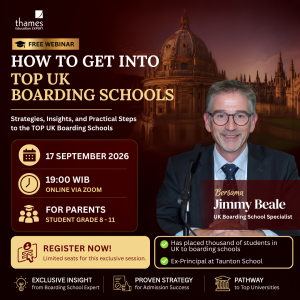
If you want to understand the value and reality of boarding school beyond rankings and promotional materials, Thames Education Expert will host a FREE WEBINAR with Jimmy Beale, UK Boarding School Specialist.
Topic:
How to Get into Top UK Boarding Schools
Date:
17 September 2026
Time:
19.00 WIB
Format:
Online via Zoom
The session will help families explore the boarding school journey and gain a deeper understanding of what to consider when choosing the right environment for a student’s academic and personal development.
This webinar is a valuable starting point for parents who are still asking:
“Apa sebenarnya boarding school yang tepat untuk anak saya?”
Take the Conversation Further: Meet UK Boarding School Representatives in Jakarta

Understanding the principles behind a traditional boarding school is one thing.
But hearing directly from the schools themselves is another.
Following the webinar, Thames Education Expert will also hold an offline seminar in Jakarta on 3 October 2026, featuring representatives from:
d’Overbroeck’s, Oxford
A UK independent school offering day and boarding education with programmes spanning Senior School, International School, and Sixth Form. The school emphasises personalised learning and combines academic ambition with individual support.
The Village School
Families will also have the opportunity to hear directly from the school’s representative and explore whether its educational approach could match their child’s future goals.
The seminar gives parents the opportunity to move from general information to more meaningful conversations about school fit, student readiness, academic pathways, and boarding life.
Because ultimately, choosing a boarding school is not simply about choosing a name.
It is about choosing the environment where your child may spend some of their most formative years.
The Right School Starts With the Right Questions
A traditional boarding school can offer much more than an academic qualification.
For the right student, it can become a place to build independence, confidence, friendships, academic focus, and readiness for university.
But every student is different.
That is why Thames Education Expert encourages families to look beyond rankings and ask deeper questions about fit, support, academic pathways, and the kind of person their child can become within a particular school environment.
Start by joining our FREE WEBINAR with Jimmy Beale on 17 September 2026, then continue the conversation at our offline UK Boarding School Seminar in Jakarta on 3 October 2026 with representatives from d’Overbroeck’s and The Village School.
The best boarding school is not simply the most prestigious one. It is the one where your child has the right environment to grow.
Not Sure Which UK Boarding School Is Right for Your Child?
Join our upcoming events and speak with boarding school experts to better understand the options, admissions journey, and the environment that best matches your child’s goals.
[REGISTER FOR THE FREE WEBINAR – 17 SEPTEMBER 2026]
[LEARN MORE ABOUT THE UK BOARDING SCHOOL SEMINAR – 3 OCTOBER 2026]